
If one finds oneself in eastern Ohio, as we so often do, you can't avoid seeing Glorious Stingle, the City by the Things. Glorious Stingle is well-known as the ice cream capital of the province, having won nearly every award for the confection there is. Indeed, the prefix "Glorious" was awarded to the town of Stingle by Harper himself, after he stopped by the province and tasted some "Mint Chip Surprise" in a local eatery. The secret of the town's delicious ice cream, residents tell me, is their giant cow Steve, an escapee from the HydroDoris research farms. Steve was created by HydroDoris as a prototype of a giant race of cows made to provide top-quality dairy supplies to off-shore oil concerns. But HydroDoris (a subsidiary of the Mexican Unigrow conglomerate) did not realize the sheer power of their prototype until it was too late; by the age of 50 (two in human years), Steve was able to walk through transparisteel without difficulty. Try as HydroDoris might, they could not contain Steve, and she wandered throughout the Provinces, settling at last in Stingle, as Stingle's residents were the first ones who didn't try and make giant steaks out of her. A comfortable agreement was reached; Stingle would protect Steve from steak-seeking interlopers, and Steve would provide the residents with top-quality dairy supplies. And thus, Glorious Stingle's ice cream legend was born. To walk down Glorious Stingle's main street is to be swathed and doused with ice cream as one might be swathed and doused with odorous oils in the most perverted of Turkish salons. You cannot escape Glorious Stingle without eating at least forty scoops of their private reserve-caliber dessert, nor would you want to. There are over 750 distinct ice cream-selling entities within the confines of Glorious Stingle, and double that amount of ice cream distilleries for export only. Glorious Stingle is a haven not just for Steve, but also for the world's ice cream lovers. As with many eastern Ohio towns, Glorious Stingle is not immune to the recent danger of attacks by the venomous, feral Amish, but the residents have fought them off before, and claim that another attack is of little concern to them. I spoke to Reebus Poprin, a local toppings specialist, who lost his arm after a bite from what the townspeople refer to as "a Silas". "Yes, I concede that the venomous, tricky Amish used to be a pretty major concern around here," Reebus said, "but between Steve, our system of waffle cone punji sticks, and our constitutionally-protected right to bear sharpened ice cream scoops [which are ever-present in Glorious Stingle], I'm not worried. We're a lot better-prepared than we were when I lost ol' grabby here." The Amish seem to be the town's only concern. Ice cream futures rose over a thousand percent last year alone, and continue to rise. "It's a good, stable currency," remarked town councilman H. J. T. Pieterhoops, "as long as you keep it between about negative twenty and negative five fahrenheit." And, as Steve is in excellent health, there's no reason why the town's dominance in the field can't continue. As it stands, Glorious Stingle is an excellent little place, and I can't recommend a visit highly enough.
Tacticruel
Yo, gentle sirs, this mah Every-Day Carry.
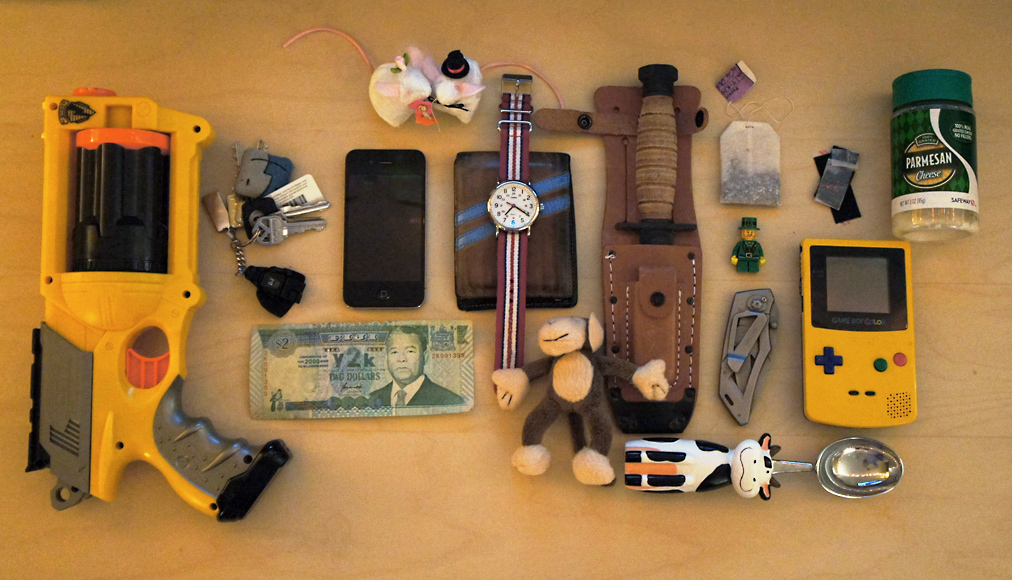
Observe this fine configuration, fellow douchebags! Bask in your gel as I review, from Left to Right, the carried-every-day accoutrements of my magnificence.
- One should never be without a NERF sidearm, for when SHTFAYPYALDAC, a few well-placed darts offer a handy escape from any situation. I prefer this modified Maverick, with custom-made "Australian's Nightmare" hypersonic darts.
- Keys can be used to open things. As I drive primarily A4s and 328is, my keychain is mainly used to hold keys to the safety deposit boxes in which I keep my car remotes.
- This is Fijian money, which is like US American money but imported. You can taste the difference, friends. This one also says Y2K on it, which I like in an ironic fashion, and also I secretly suspect it protects my computers.
- This is my cell-phone telephone, Gerald. Gerald is an iPhone 4, not a 4 S, because I am old-money.
- I keep these mice getting married in my pocket to remind myself that women are the same species as me.
- This is a watch I glued to a wallet. In Europe it's called "Scrillazeit".
- This is a monkey. Most people don't carry one, but I do because YOU NEVER KNOW.
- This is my Mountainfast® Kabarbeque knife. It's made in Vietnam by ironic Vietnamese people. It's good for stuff like opening cans, or puncturing cologne bottles to douse myself in.
- Here's my ice cream scoop.
- I keep some tea on me at all times, coffee is bad for you.
- This is a leprechaun; the one time I didn't take him with me my portfolio went down 4%, so now I do.
- This is my other knife. I use it to help get the Mountainfast® out of its holder when it gets stuck.
- Some Velcro, for the ladies.
- A Game Boy Color, just in case.
- My 'san.
With this arrangement, I am ensured of complete dominance over any situation, like if the mailman comes, or if I feel ennui.
Hocoa 2
Traveling north, we soon arrive at Planks Town, Virginia. Planks Town is known throughout the region as the original home of Trench-Rapist Autos, the Quebec carmaker whose infamous entry into Chapter 11 bankruptcy last year caused the nation of Austria to be dissected into small parts and sold to drug-crazed Russians at bargain-basement prices for intravenous injection. I decided to stop in Planks Town and see what remained of the old Trench-Rapist spirit. "The T-R boys had to pack up and leave 'round about aught-four," said Stunkbug Lee, chairman of the Planks Town JCC and my tour guide. "The factory was folded back up into a cement mixer, but all the rest's still up." Indeed it is; the town is littered with bits of history. The Zeppelin Field, where Trench-Rapist founder Diane Fish was challenged to a rap battle by Time-Lord Soichiro Honda, is probably the town's centerpiece, although Fish's girlhood home is of architectural interest as well as historical, as it's composed of 144 distinct polyhedra in the finest Civil War-era architectural tradition. "Lot of history in them polyhedra," Stunkbug Jones said: "There was actually a plan to move 'em to [current T-R home] Roberval, but some of those Stanislaus boys caught the helicopter on the ground and pumped it full of jam." Other notable T-R relics include the church where Fish prayed to George Lucas to stop, the tomb of four hundred thousand Trench-Rapist-DeSotos, the platinum bust of Bob Lutz that once served as the T-R factory's "hood ornament," and the abandoned prototype of a T-R arctic exploration crawler/party bus. All of these sights are easily-accessible from Planks Town's depressing town center. Although Trench-Rapist has departed, Planks Town still seems to hold to their bitter rivalry with Olio, Pennsylvania, home of T-R rival Stanislaus. References to Stanislaus and "those foul and depraved citizens of Olio" fill the Planks Town newspaper whenever anything bad happens, and effigies of Olio mayor Roblipson Gloris and Stanislaus head Ed "Steamboat" Sunflowers are still burned in Planks Town streets at every sundown. Even strolling down the market street one afternoon, I was struck by how fiercely loyal Planks Town residents are to the departed Trench-Rapist. Local eel merchant Elvie Raymond said it most succinctly: "I wants to put an eel in "Steamboat" Sunflowers." But behind this stirring rhetoric, Planks Town has issues. Aside from a total lack of any reason to visit besides the observation of Trench-Rapist leave-behinds, the town's financially-ruinous decision to bankroll a venture entitled "Trench-Rapist 2: The Trenchening" collapsed majestically under a sea of lawyers visible from the Mir space station, and the remaining industries — sulfur mining and eel husbandry, primarily — barely allow the residents a subsistence-level income. The average Planks Tonian lives in a three-room dirt igloo, eats one meal of twigs a day, and shares an out-door toilet with up to 400 other residents. "And that's not the half of it," says Planks Town interim mayor Stevenson Wellbrox. "There's no fire department, but everything's made out of dirt so that isn't actually a big concern. Likewise no cops, but we don't have much. No government schools, thank God. And the sewer system has been swarming with eels for a decade. You turn on your water tap and eels just come out. Utilities are a big concern for the city government." Nevertheless, Planks Town retains a certain rustic, eel-infested charm. Beyond the copious amounts of Trench-Rapist history on view, the town's culinary creativity is renowned, and local bed-and-breakfasts are famous in the region for their possession of beds and breakfasts—rare commodities in what we now know as Virginia. Planks Town is well-known as the "second home" of media conglomerate Comcast-Vanadium, and the literacy rate approaches 3%. But strolling down the street, one cannot help but notice the vile gleam in the eyes of passers-by, as they see a newcomer who lives in a real house, with real plumbing, and no eels. Planks Town has suffered greatly in the wake of Trench-Rapist's departure, but the residents themselves have suffered more.
Hocoa 1
It's easy to imagine the screaming, naked Weasel of Truth bounding across our associated territories, but in this day and age — when so many of us are employed as computer-wipes, or bebop theorists, with commensurate never-ending hours — you just don't get the opportunity to traverse our lands and observe the circumstances and conditions in which their inhabitants labor. Not like you used to, certainly; for, as recently as 1997, it was common enough to unhitch the family therapede and escape north, east, west, south, or occasionally up. One misses the open road, and the Canadian Provincial dream it represents and allows. And such is my goal in writing this travelogue; it is a journey across the domain we are all too preoccupied to see, observing local sights, phenomena, notable hobos, areas rife with meat-packing detritus, and a new element I call tribarithene, which so-called "experts" have yet to acknowledge. We begin our journey in Speebo, Domain of North Carolinus. This sleepy little down-home 'burg hovers twenty-three meters above the ruins of Old Speebo, just north of the Noble Hatchapoopla river. In the early 1980s Old Speebo, called Speebo at the time, was a thriving North Carolinus slave port, legally sheltered from the 13th Amendment of the then-USA's Constitution by a little-known "Eyyyyyyy" allowance in the North Carolinus regional home owner's association by-laws. Slavery in pre-Harperian Old Speebo was a confusing and demoralizing affair; slaves were often underprivileged individuals captured in extracontinental war zones and transported against their will to Speebo in giant styrofoam coolers. Upon arriving in Speebo, these new slaves would be freed, becoming the new ruling class, and everyone else in Speebo would willingly — if grudgingly — become their slaves. The life of Speebo's ruling class was thus chiefly occupied with preventing any new slaves from being transported to Speebo. Typically, this proved futile, as the millions upon millions of slave-packed giant styrofoam coolers washing up upon Speebo's shore were too much for the under-funded, slave-staffed Coast Guard, who didn't really care if any new slaves showed up.Life in Old Speebo was thus messy, brutal, but — thanks to advances in medicine and agriculture — very long, with the average resident living to the age of 166. As the population of Speebo neared one billion, with more slave-coolers showing up every day, the society struggled to support itself. Food, water, and land were of little concern, but Speebin society craved Reeboks, imported from outside the city walls. Reeboks were a required and ubiquitous part of Speebin life, essential to finding a good job, a mate of the desired gender, and TV of suitable girth. But the Reebok factories in far-flung China were drastically underprepared for the Speebin demand, as larges swathes of their workforce tended to get floated to Speebo as slaves. Within the walls of Speebo, rage and dissent built as supplies of the treasured Reeboks were exhausted — there was no end to the shortage, as Reeboks were used, burnt, buried, traded, stolen, or eaten. Speebin society neared a crisis-point. As tensions broiled, a man named Martin "What In The Hell" van Jeerkson won the Speebo Gouveurneurship, and became infamous for an ill-considered plan to shift Speebo's currency away from the Reebok Standard. Faced with the loss of their investment, wealthy foreigners gathered up their hoarded Reeboks and fled Speebo. Van Jeerkson panicked, launching a hasty initiative to get Speebins to accept Filas instead, but the damage was done, and Old Speebo collapsed, nearly overnight, as millions died alone in their huge mansions, without Reeboks. The few left alive fled back across the seas, in hopes that the meager scraps of Reebok they still possessed would curry favor with the local warlords of their homelands. Van Jeerkson, muttering the famous words that became his nick-name, moved to Belgium, where he became a famous Tipso Suarez impersonator. Left unattended, Speebo's fusion reactor — "Old Wheezy" — sustained the hulk of the city for several months, but eventually surged and erupted, bathing Speebo in the plasmic fury of a thousand suns. The explosion of Old Wheezy could be seen on the other side of the planet. The city was ruined. All was not lost, though. The wealthy Reebokholders that had fled Old Speebo in anticipation of "What In The Hell" van Jeerkson's currency reform found themselves left with the idealism that had led them to Old Speebo in the first place, as well as many millions of Reeboks. They wondered on the creation of a new society, one that still had at its core the grace and power of the Reebok, but without the crushing influx of new slaves that Old Speebo had suffered under. They decided to create a New Speebo, hovering above the blasted ruins of the old, with all the old values but none of the old problems. Construction on the initial platform, all two thousand square miles of it, was completed twelve years later by SuperKrupp & Uncles Ironmashers, and it was towed into place. New Speebo was born, and that is the happy city we now visit. Getting to New Speebo (typically referred to as Speebo) is uncomplicated, as the floating city is served by a very precarious train, a business-as-usual airline, and a deeply confusing subway. The first things one notices about Speebo are typically the giant propellers underneath the city, each blade ninety feet long. "They don't actually hold it up," said Samterfuge Jones, Speebo's chief engineer, "but they look pretty cool." The city, in fact, is held up by a combination of lighter-than-air gas, pumped into the hull of the platform at the time of construction, and the propulsion provided by its residents. "We face up when we breathe in, and we face down when we breathe out," said one citizen. "Honestly, you stop thinking about it after a week." At first I presumed this unlikely, since Speebins are well-known for their small respiratory tidal capacity, but indeed it seems true, as gasp-worthy public announcements are typically accompanied by the city settling a few meters closer to the ruins of Old Speebo, and then rising up again when citizens resume breathing-as-usual. This unlikely system has worked well for the past hundred years, and citizens are proud to note that it may work well for another few months, at the very least. If there is a national sentiment in Speebo, it is "What?" and "Stop talking to me." The city itself is a clean, pine-scented wonder of a place, not unlike Singapore or Halifax, and now that the citizenry are secure in their Reebokholding, strife is typically absent from daily life. At restaurants like O'Shaunigan's Authentic Chinese Hambutts, Speebins from all walks of life gather to compare Reeboks, sing annoying national tunes, and peer-review each other's outfits. Thanks to effective manipulation of international carbon credit-trading schemes, Speebo's GDP is largely composed of fictitious exports for overseas manufacturers. As a result, only ten percent of Speebins are employed, typically in education, retail, and warp field plumbing. The rest while away their time on various Reebok-related tasks, or brush up on their outsider art. Personally, I like Speebo, although I found there to be little to do if one is not interested in Reeboks or local Reebok-related habits. But the inhabitants are happy, and according to Generalissimo T-Bone "Parsnip" McGee, Speebo's tourism chief, not one among them wishes for a return to the heady days of Old Speebo. "We don't even look down that much, really," said McGee. The Speebins have their Reeboks, and they are satisfied.
Here are Beeps
Here is an hour of classic rock ripoffs in a little beep-tone stereo compilation we here like to refer to as Tunez To Resurrect Bob Lutz To!

Fixing one's climate control
I couldn't find a detailed guide to this, so I made one just in case.

The W123 HVAC is pretty funny, because half of it relies on vacuum actuators and stuff (if your center vents don't work, that's why), and the other half relies on PCBs soldered at 90° to each other and then subjected to (usually) diesel vibration for 30 years. Failure of the latter can cause the HVAC not to come on, to come on sporadically, or to come on full-heat or -cool. So re-soldering is a good way to go. Let's do that... The first step is to pry the wood off. It's held on by four pegs, and if you side a flathead driver behind it, it'll just pop right off. Then you're left with this.

Removing the unit as a whole is pretty simple. One removes the upper-left and -right screws, puts a flathead driver into one of the flat apertures inboards from either now-vacant screwhole, and rotates the unit down, pivoting on tabs that sit above the radio. That gives one this.

Wiggle the lights free (now is a great time to change them), and only two large connectors on either side remain. Removal is straight-forward.
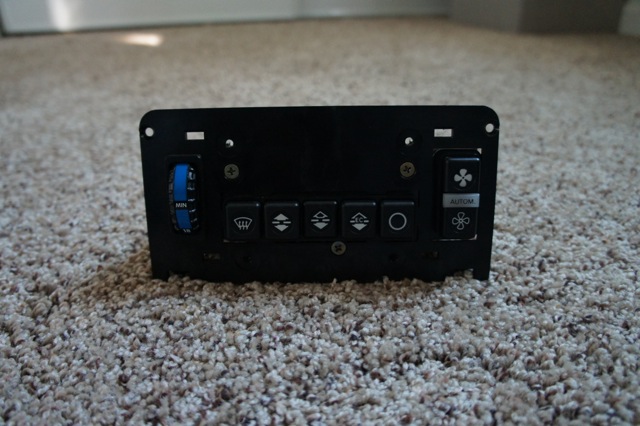
Once the thing is out, remove the faceplate by undoing the remaining three Philips-head screwdrivers. That leaves the unit itself. The next step is to remove the temperature wheel—pretty straight-forwards. Just compress the clip on the top with needle-nose pliers and pull the wheel module off. Careful with the clip.


Pop. Next, we'll take the cover off the fan-speed switch. This is pretty straight-forwards too. There's three clips, one on each side. Take a flathead to them. Keep track of the little pivot inside the fan-speed box. It goes long side-up. The next step is to remove the bezel around the buttons. One clip on the top, two on the bottom, and it pops free. But it won't come off. Before that, one has to push the buttons out from behind the bezel, now that it's loose. I find that inserting a big flathead wrapped with a layer of electrical tape, then rotating it 90°, works well. The "AUTOM." button is a bit tough. But the buttons pop off, and then the bezel comes free.


The next step is simple. Remove the light pipe.

Now we're getting somewhere. Next, we'll look on the back of the unit, and find three big clips holding on the piece with the part number. Take the flathead to them, and then pivot the piece off.


Now turn the unit over. Repeat the procedure to remove the temperature wheel to get the fan speed module off. Careful of the clip, once more.

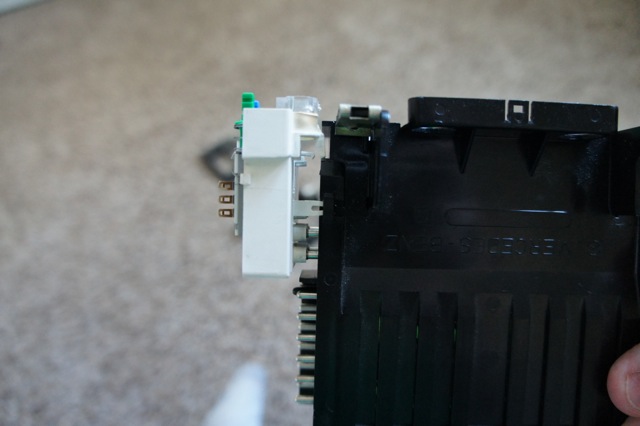
Now we have the main unit alone. Turn it so that you're looking at the PCB, and, using the tape-wrapped flathead, pivot it open from the back of the unit.


Remove it entirely. Now repair is just a simple matter of re-flowing all the solder connections that join the 90° board's traces to the main board, on each side, and repeating this procedure in reverse. I might also suggest using something to clean the pins on the side, and using dielectric grease when you're plugging them back in. The latter two pictures in this series show dirty and cleaned pins respectively, for reference.


Vaddington L. Bear's Big Swedish Car Business Day Out and whatever
Note: This is a JM Classique™ post. Photobucket are a commercially-operated research seaplane of some kind, where was I going with this? I wish my job was flying seaplanes, and broke image links from ten years ago, removing the images from old forum posts. Since I’m going through each old post and re-hosting the image on this server, I figured I might as well shove the post here, too. JM Classique™: Your Trusted Brand of Yestercrap.
Once upon a time there was a company called SAAB, and they lost their monies, or misplaced them, or at any rate they didn't have any any more. This was a bad thing for SAAB, and they stopped making cars, which was what they did and I just didn't mention it because the context should have made that clear. A million billion and seven-eighths miles a way, a young tycoon named Vaddington L. Bear Esq. woke up and realized that he had lots of monies! This made him very happy, and he decided to go absorb SAAB (whose troubles he had heard of using a wireless radio) into his moobclave and use his monies to help them.
 When he got there, SAAB was all messed-up. The thingy had fallen off whatever and they had no beaver statues. Vaddington L. Bear Esq. tried yelling on-the-spot guidance at them, but that didn’t help. He decided that he would help SAAB by using his monies, despite the counter-revolutionary thought such an action would entail.
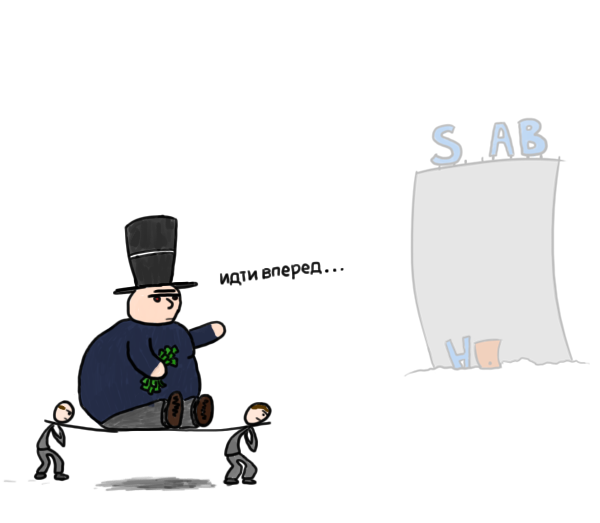 Unfortunately, Vaddington discovered that SAAB’s creditors (which is a thing imported from the decadent West, whereby foul goblins disrupt your self-reliance and have sex with your family) wouldn’t give SAAB to him! They wanted more monies—and they knew somebody with almost as much monies as Vaddington had...
 Vaddington L. Bear disagreed.
 After the creditors were dead, Vaddington marched right into the factory. “I have monies,” he announced, “Western imperialist monies!” The trolls inside jumped for joy, because now they could do the things they did before they ran out of their own monies—frolic and build cars and besmirch Volvo and race swans. They adored Vaddington, even though he ate a couple of them, and they crowned him the new Most-Equal of SAAB. He reigned over the People’s SAAB Construction and Marketing Combine no. 34 for a thousand years, with an iron fist and a loving claw, and the trolls lived happily ever after.


Aranciata

Ahpers

Ameerica
