LOCAL NODE 2012-10-04

Follow-up: Putting an Nvidia 670 in a Mac Pro

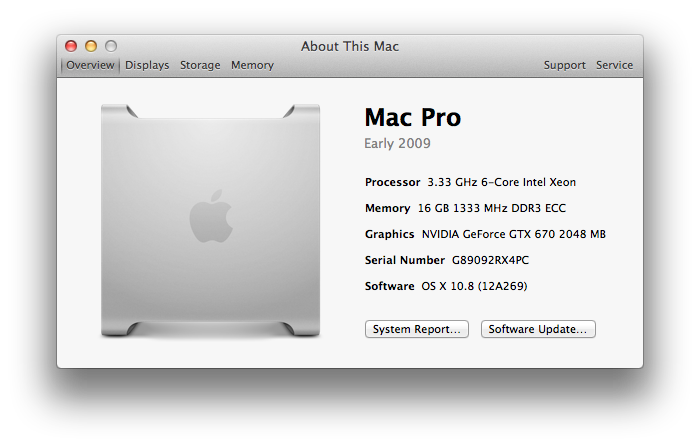
I returned the EVGA because it just wasn't worth the fuss, but then Nvidia started releasing their own OS X drivers, so I thought I'd give it another shot. I got another 670, an Asus DirectCU II, and tried it again.

The card uses a different style of cooler than the 5870 and EVGA 670 FTW, which I thought might help with the heat concerns. It also looks nifty!
Installation was totally normal, as usual. I didn't have issues with the EVGA in Slot 1, but someone was reporting trouble; as they're both x16, I figured I might as well put it in Slot 2 to get some cool air 'round the back anyway. Probably made no difference to temperature or stability. Whatever. It booted up just fine, and I installed the newest OS X drivers from Nvidia, as well as Asus' GPUTweak thing in Windows. That came with an older driver (301.something?), so I installed the newest 306 drivers on the Windows side.
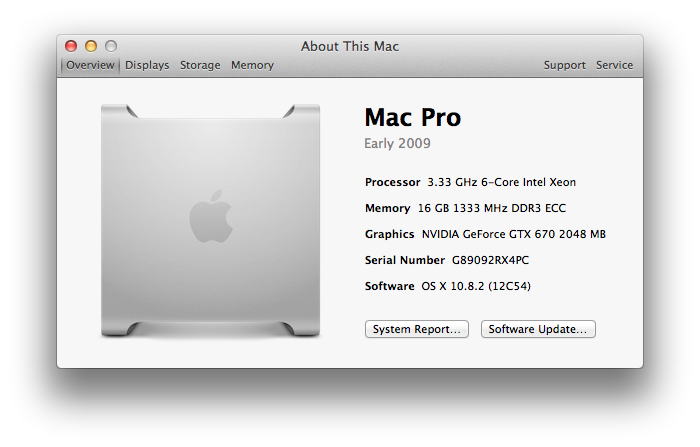
So far, so good...
Luxmark is slightly worse than the EVGA.
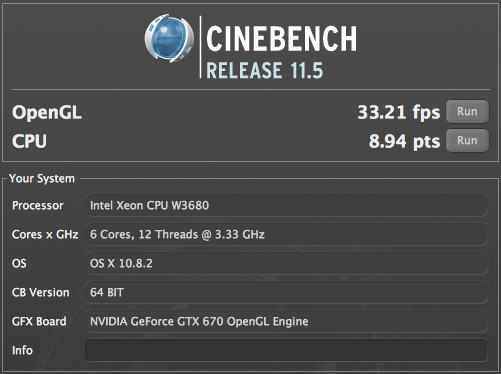
Cinebench is only marginally better than the EVGA, and still worse than the Apple 5870.
Games were the same. Most things are slightly faster than the 5870, Source games have a tiny bit of microstutter (but are just fine), Civ 5 still has numerous graphical glitches, and the wrapped version of Skyrim still sucks (plays beautifully under Windows, of course). I was hoping for an improvement to everything, with the new drivers from Nvidia, but an improvement to anything would have been nice. Long story short, there still isn't a worthwhile difference in game performance between the 5870 and 670 under Mac OS. Unless you only play WoW.
The card's non-reference cooler was fine. I put in some vented PCI slot covers (as the Asus blows up, not out, and I wanted some way for the hot air to escape), and that was that. The PCI bay fan ran faster, but temperatures were the same. The Asus was significantly quieter than the EVGA or the 5870. I didn't notice the rear hard drives (on which the Asus 670 exhausts) to get very hot; they reported about a 10°F increase over the 5870. The PCI fan must have been keeping most of the air off 'em.
The real problems are in Windows. Asus' software is kind of crappy, but functional. Most games were great — Skyrim, New Vegas, and so on — but World of Tanks had really horrible microstuttering, regardless of AA, V-sync, or any other graphics settings in the game or Nvidia's control panel. Hours and hours of screwing with settings, driver versions, and so on later, I pulled the goddamn thing out and threw the 5870 back in. Given how few reports of the problem there are, I expect it's some arcane conflict with Apple's Boot Camp drivers. Maybe I'll try again this afternoon, or maybe I'll just return it and use the $400 to go on a nice trip somewhere with R. Monkeys. It is to some degree worth all the crap (dang, Skyrim looked nice), but the point at which it isn't approaches fairly rapidly.
Edit: Solved! Hardware fault, according to ASUS. Exchanged 670 for another EVGA FTW — works fine. Done!

LOCAL NODE 2012-09-28

Huset, Apiologist Extraordinaire

A list of French Avant-Garde filmmakers whose works you are now familiar with: Serge Manadar Born in Tangier, Morocco, Manadar rose to preeminence in the genre following the 1976 release of his third film "La souffrance est la sufferance", the plot of which concerned the nameless, faceless narrator's attempt to come to grips with the failure of his uncle's career in NASCAR. Manadar continued to crap out highly-regarded work throughout the '70s and '80s, culminating in his Golden Buttflap award at the 1987 Zurich Film-Liebhaberpartei for "J'avais l'habitude d'être un personne", which charted the growth of several shrubs native to the Uzbek steppes, and juxtaposed that with sexual assault. Manadar continues to make short films under a rotating series of assumed names, but due to his expulsion from the Film Ligue de Napoléon (who were jealous of his France-wide success), he is unable to release his films in a format viewable by bipeds. Unknown to most, Jacques-Yves Cousteau was merely one of Manadar's disguises. Christodou "U" Breziere Breziere's work first began appearing in cinemathequeopolitronesses in 1973, when he attained instant fame for "Je ne suis pas celui qui respire", an animated snuff film in which a protagonist named for Breziere attempts to acknowledge his fascination with pinching womens' noses. The work was shown to over 40,000 people each day, and a still from the film remains on the city flag of Moche-Metz, in the Rhône valley. The bulk of Breziere's subsequent work is composed of a series of grouchy reminiscences on the transient popularity of the Avant-Garde filmmaker, the most notable of which is 1979's "Salauds! Pourquoi ne pas regarder mes films?" Breziere has since retired, and lives with his robotic fiancée Robertiñho in a houseboat on the Charente. Michel Wallenhuis The Belgian émigré's first film, 1977's "Regardez mon cul, pleurnichards", was notable for being the first film to depict an overweight, irate man's existential suffering. The manner in which it did so, by having the protagonist scream bizarrely-specific insults at the camera for six hours, resulted in immense critical praise for Wallenhuis, but the film met with limited commercial success. "I made ten francs from the entire fucking thing", he claimed in a 1994 interview with "Belgian Losers", a program on Nederlandse Publieke Omroep's Radio 5. Wallenhuis quit the film business after failing to secure funding for any further projects, and spent the '80s and '90s as a bookkeeper specializing in bets on the success or failure of the Russian Mir space station. His current whereabouts are unknown. Un clone de Serge Manadar Popularly known as "Un Clone," Un clone de Serge Manadar was the result of a French government project to encourage the adoption of French culture in Algeria in the years following that country's independence. Un Clone was a direct clone of Serge Manadar, and, with the backing of the Ministère de la Culture, produced a staggering amount of films in the late '70s, including "J'ai peur de Pierre", "L'ennui morne matin", and "Donc, très solitaire, dans cette foul". However, the cloning process was imperfect, and cellular degradation began to take hold. Un Clone's final films ("Me regarder dissoudre" and "Sexe avec le cadavre de Georges Pompidou") have been written off as confusing and literalist. Un Clone dissolved on March 23rd, 1980. Alain Barbé-Marbois The reclusive director of "Je suis triste du coude" had a troubled childhood in Paris' 7400th Arrondissement, before escaping in a barley train to join a traveling accounting firm (a journey detailed in 1973's "La douleur est le seul bonheur"). He was a well-regarded accountant on film and television productions, but longed to direct. After stealing several cameras, lenses, and actors from one of "U" Breziere's productions, Barbé-Marbois made a string of filmotropic maladies that were released straight to shadow puppet reenactors before finding success with 1975's "Merde est le ciel, merde est mon coeur", the unexpected sensation of the year's award shows. Barbé-Marbois, finding that success had made him money, immediately burned all his film stock, and declared that he would, from that point, "only do unpopular things, like murder, or fiscal irregularities". Depressed by the contemplation of success, Barbé-Marbois' last moment of notability was a defection into East Germany, where he achieved recognition in the country's literary underground for his publication of "Meine Traurigkeit ist Komplette", a novel that could only be read while submerged in mineral oil.

LOCAL NODE 2012-09-18

Hoxotravail

I thought I put this here before, but evidently I didn't...
LOCAL NODE 2012-09-17

ėŠĪ폎ėļ  ë‰īėŠĪ

I have been lobbying all appropriate Dutch (and even inappropriate Belgian) authorities to put me in charge of all current and future ultra-marathons and ultra-triathlons. I've been writing exhaustive and excruciating letters to the Nederlandse Sport Federatie, because their email address is pretty easy to find, my Dutch is reasonable, and korea@korea-dpr.com doesn't respond to anything that doesn't contain delicious currency of the imperialist West. This will not do, as I merely propose a series of a events for overenergetic rich nutjobs. The Dutch do not respond! The Grosjean Three-Arm 10000: A man is forced to wear a sheep like a backpack. He must feed and educate the sheep while being pursued over a 40-mile obstacle course by Uzbek mercenaries. If the racer is captured by the Uzbeks, they will take his sheep and raise it in their native tradition. Obstacles include mud traps, mud holes, mud ladders, and mud walls. A timer is implanted in the racer's arm, and will continue counting down after the race, to an actuarially-determined point at which the racer will die. The winner is the racer who completes the race the fastest with the most well-rounded sheep. Meanwhile, cameramen battle each other in a vicious blood-sport where the winner gets a job making documentaries. The Saumarez Dynacrumble: Participants race for 400 meters while carrying a 40-foot stone statue of Saumarez. If they cannot lift it, they are shot. The only documented winner of this race is Saumarez. WingRun '09, For The Kids With No Homes: Participants obtain their own helicopter transport to Iqaluit, where they must immediately don duck suits. Their BAC must be at least .15, and they must spend the whole race holding wings with another duck whose political positions they disagree with. It is a double-length triathlon, and air horns are provided for noisemaking. Each pair of ducks is provided with one balloon-tire bicycle, and it must be occupied by one or more ducks at all times, even during the aquatic portion of the race. Circling gunships will eliminate anyone who tries to use flashlights to break the endless Arctic night. First prize is a poorly-built catamaran. Mijn Verdachte Oma: In a rare "triple-double-ulta-secret" marathon, participants must go about their lives, and never reveal that they are participants in a marathon. They must become grandparents, and visit every Wendy's franchise in the world. Participants periodically receive a vision of a cow called Morris, who knows what they will do before they do it. The winner receives immortality and resistance to bees. The Poisoned Granule 10K: Participants are para-dropped into a pan-dimensional rainforest with a short-wave radio, a hundred dollars in gold, a hundred dollars in rubles, and a flute. They must hike out of the rainforest without going mad in the ethereal wasteland in between the dimensional planes, and become proficient in the quasi-musical language of the beings that inhabit it. Extra time bonuses will be awarded to the racer who can punch themselves the most. The short-wave radios must be tuned to numbers stations at all times, and racers must have pinpointed their location via pan-dimensional triangulation by the time they return. Race organizers are free to add up to 400 extra miles to the race, to compensate for destructive Belgian influences. Participants are expected to use their pan-dimensional privileges to rob nearby department stores, and turn "findings" over to the race organizers.

LOCAL NODE 2012-08-07

Putting a GeForce GTX 670 in a Mac Pro

Update from 2017: This post is five years old now, but lots of people still find it through Google. So I thought I'd update it just to say that I sold the Mac Pro with an Nvidia card to my dad, and it has been working fine through the various OS upgrades. Googling around suggests that the 10x0 cards work fine in Mac Pros too. I replaced my Pro with a MacBook Air and a custom gaming PC, but I think the 4,1/5,1 Pro remains a really good computer.

---

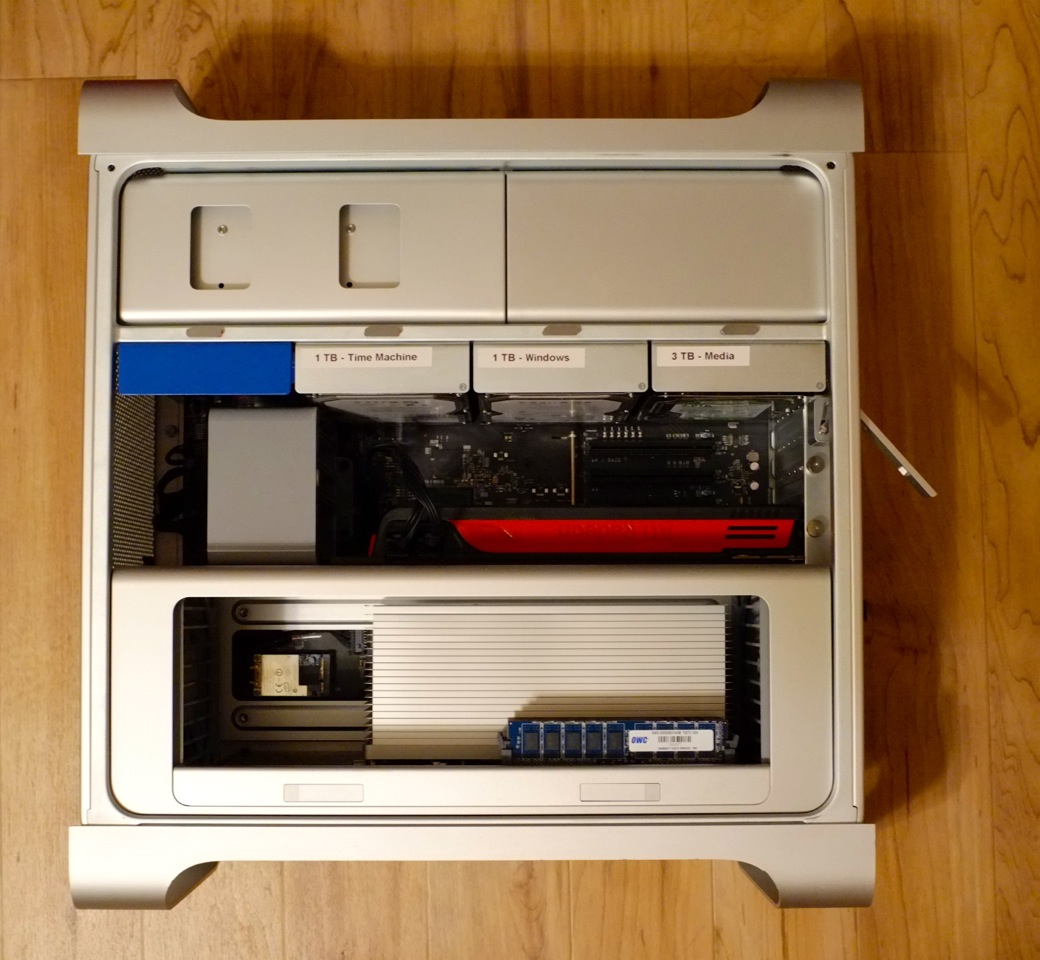
I thought I'd try dropping a GeForce GTX 670 into my Mac Pro, since apparently 10.8 can drive it (you just won't get the EFI boot screens). I bought the 2GB EVGA 670 FTW, mostly since that has two six-pin power plugs. The top OEM card for the Mac Pro is the Radeon 5870, which is a good card but also pretty old, so — on paper — the 670 is a nice upgrade. The 670 is actually a little cheaper, too. The drivers in Mac OS are still pretty immature, so my goal was to get equal-or-slightly-better performance for now, and way better performance in Windows. Installing it is pretty straight-forward, if you've ever done computer stuff at all. Here's my Mac Pro as it sat, with the 5870.

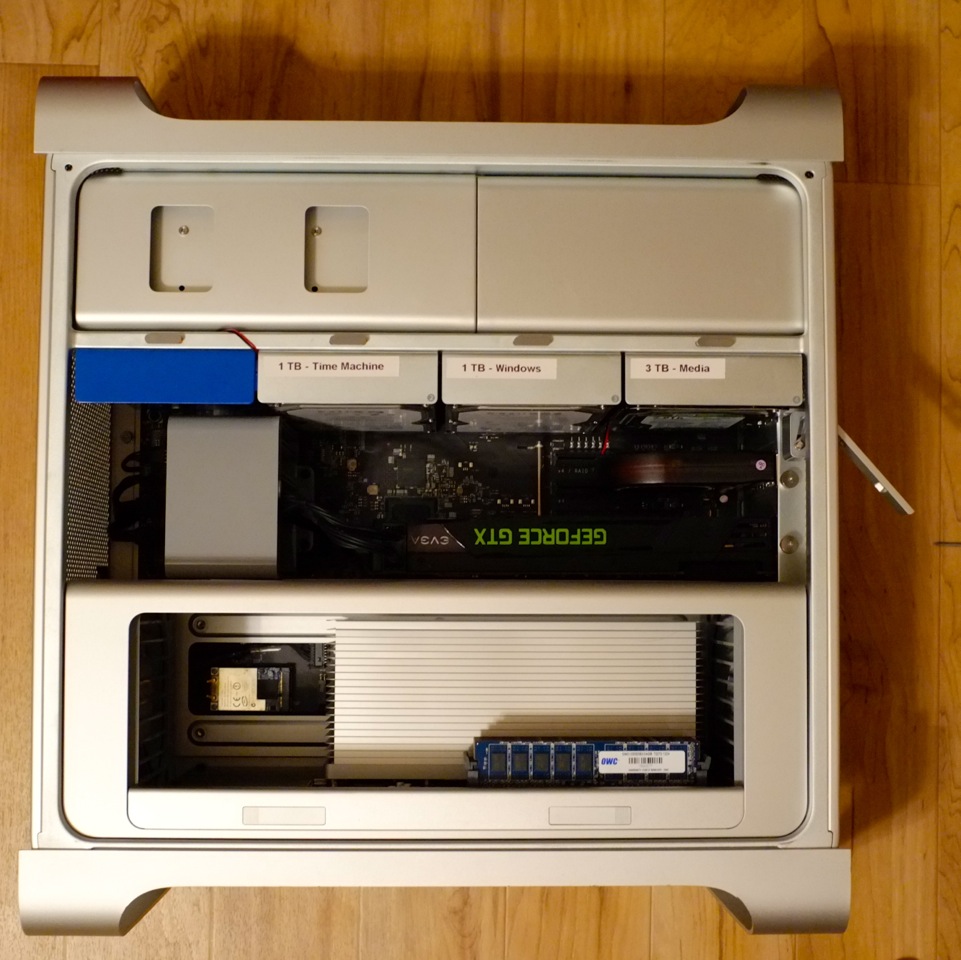
The 670 is a little smaller.

The 670 dropped right into the 5870's spot, and hooked up to its power plugs. These are standard parts, of course, so if it didn't that would mean I'm really dumb. You can see that I also put in a little PCI fan (powered from the spare optical drive SATA port, and a SATA-to-Molex adapter). This pushed a lot of air, but it was really noisy, and it didn't seem to make much difference; the only thing making much heat in the PCI bay is the GPU (the rear hard drives being idle most of the time), and both the 5870 and 670 keep their heat fairly contained in those plastic shrouds, and push it out the back. Maybe the fan did a little something, but it wasn't worth the noise. So, the little PCI fan is gone now.

So I did that, and it booted. That was nice. You don't get the grey boot screen (the video drivers loads when the OS does, so it appears to boot straight to the desktop). With the fast SSD booting, it was just, like, "push button, wait 20 seconds, be at desktop". The obvious problem is that if you find yourself looking at the startup manager a lot, this is a bad solution -- you no longer get that. In that case, it's worth keeping things OEM or finding a flashed Nvidia card that gives you the boot screen.

Anyhow, it worked just fine. I went to run benchmarks, and LuxMark couldn't load. No OpenCL. So I found a fix from Netkas, installed it, and hey, liftoff. So, here are benchmarks and observations.

[gallery link="file" ids="1293,1294"]  

Here's LuxMark doing Sala. That's a pretty solid improvement. I would have hoped for a bit more, but I'm not complaining. Of course, the real strength of an Nvidia card over ATI is CUDA; the 670 is probably about six million times faster in After Effects.

[gallery link="file" ids="1295,1296"]

Wait, crap. Check the GFX details; the 5870 is the first result, and the 670 is the second result. That's annoying. Cinebench is pretty dated these days, but the numbers went down! My precious numbers! Well, Kepler drivers are immature. Hopefully this changes over time.

Now, games. Everything was tested at 2560x1440 at the highest detail settings.

Starcraft 2 gained about 10 FPS (61 vs 50, average) on the 670, tested playing a Bly v. Tarson replay. So that was cool; you can see that Barefeats got the biggest improvement on a 570/580 from SC2 at those settings. Then I tried Civ 5; not only was it slower on the 670, it was kind of glitchy. Source games don't really tax the 5870, so it's hard to see much improvement in practical play, but the 670 was about 15% faster across Portal 2 and L4D2. L4D2 did have a weird bit of stutter when levels started. Dirt 2 ran great on both cards, although it remains a super-annoying game. Cities in Motion was, I think, slightly slower on the 670, but played fine. It gets jumpy with a huge map and the fastest game speed. The Sims 3 was just about as fast, too. Weirdly, Diablo 3 didn't improve at all — you'd think whatever worked for SC2 would work for D3, but no.

My wrapped version of Skyrim was the only game here that wasn't really playable on the 5870 at 2560/Ultra, so I was excited to see what the 670 did. It did nothing, actually; the game was still jumpy. If I had to cork sniff, I'd say the 5870 was more consistent — the 670 seemed to do a little better as long as you were standing still, and a little worse when you turned. This isn't really a reflection on either card.

Everything else worked fine. I'd heard people saying that Steam didn't work with PC GPUs — it did. All my non-game programs worked as well as before. Temperatures were about the same as before, and the 670 managed its fan just fine (it's quieter than the 5870, which made me nervous). Restarting in Windows showed off what the 670 could actually do, of course, although I found the difference marginally underwhelming in stuff like New Vegas and World of Tanks. But then, they're not taxing anyway, and the only tricky stuff for the 670 to add is anti-aliasing. Anyhow, the 670 in Mac OS is pretty much as fast as the 5870 except if you like Civ 5.

I ended up a little conflicted. The 670 is better than the 5870, depending on what you're doing, but not by that much in most cases except for CUDA. It's unsupported, and there were a couple glitches. The 5870, in comparison, is an OEM card that developers (presumably) test against, so you won't see much in the way of issues, and it's still the fastest OEM Mac GPU by a comfortable margin (over the iMac's 6970M). However, the 670 is definitely faster in Windows, and there's a lot of potential for the Mac drivers to improve and let the 670 really go nuts.

LOCAL NODE 2012-07-24

2009 Mac Pro W3680 Swap Addendum

I got a bunch of questions regarding the 3.33 six-core swap in my Mac Pro, so here are answers:

- When I say 10°F cooler, I mean that it idles at around 95°F now, instead of ~105°F. My Mac lives in a cabinet, so 95°F ain't bad. It gets up to 125°F when I play games or render stuff.
- I got a good deal on the W3680, so the total cost was $450 (I haven't sold my W3520 yet). If I hadn't gotten a good price, I probably would have gone with the W3570, which is the 45nm 3.2 four-core. Actually I probably should have gone with that anyway; I don't think there'd be much difference in 95% of the stuff I do, and the W3570 is $250. You can also use the LGA1366 i7s if that saves money, although they're not really any cheaper than their equivalent Xeons.
- No, you can't use the W3680 in dual-processor machines. The equivalent for dual-socket machines is the W5590. They should be around $500 each these days for used chips. That's a pretty screaming deal, since the retail price is still $1500 each.
- I don't have a Kill-a-Watt, so I can't measure power consumption, but I don't think it went up by much, judging from Apple's published specs for the 2010 vs 2009 Pros. Putting in the newer video card probably did a lot more.
- Performance isn't really any different now that I have the matched set of 1333MHz RAM in there. On the plus side, my RAM is all the same color now, which looks fancier.
- The 5,1 firmware is totally stable. Hasn't crashed or hung once. I upgraded to the 10.8 GM, and it's totally fine.
- One guy asked if it would be a good upgrade for a MacBook Pro. Um, not really.